Sunday Musings Building The T
Happy Sunday Friends!
Welcome back to another Sunday Friends! I’m glad you’re here. Here is your Sunday Musings, a quick dose of what I’m exploring and thinking about. If you find it useful, please feel free to forward this along to friends!
Building the “T”.
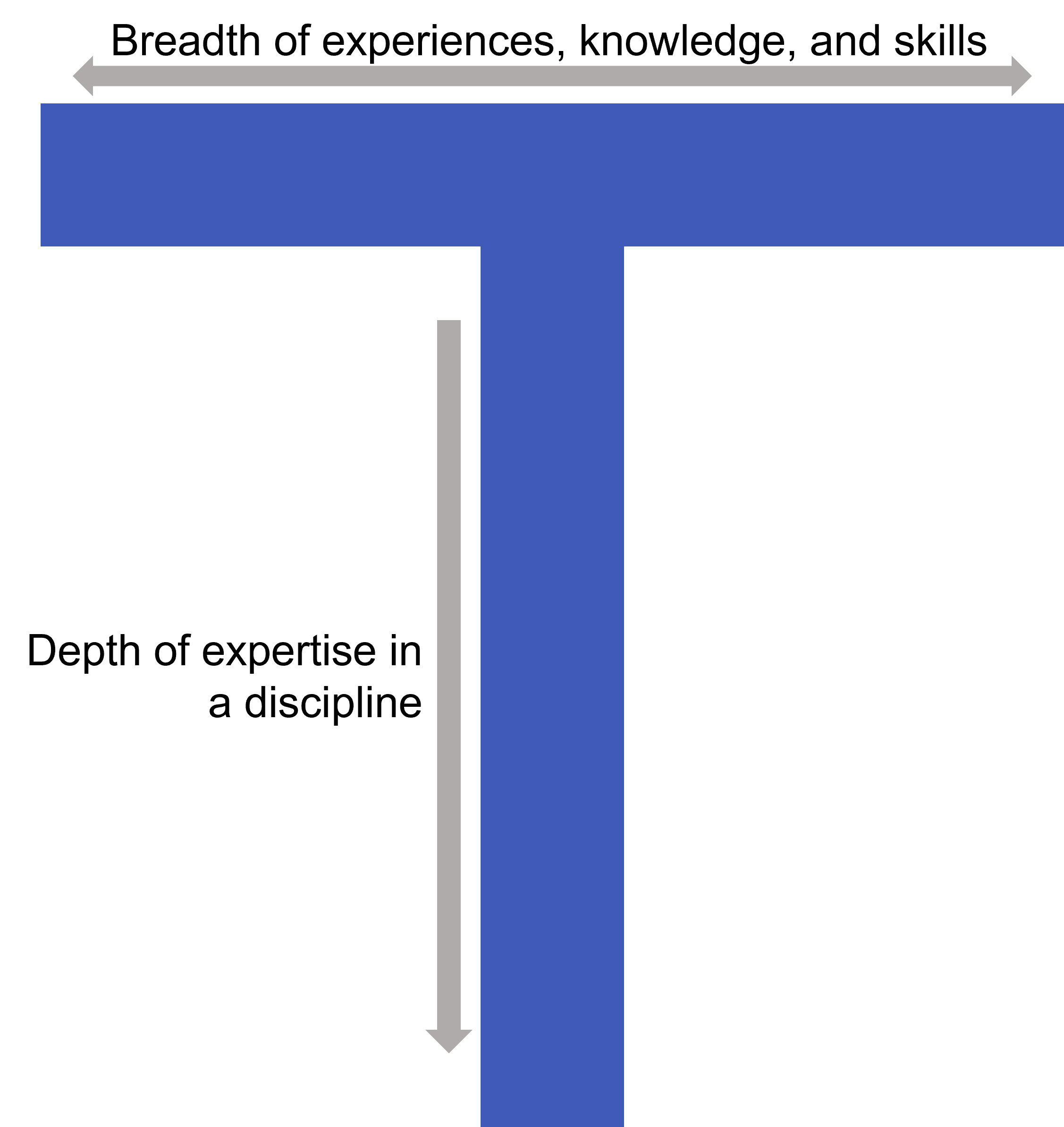
Last week I talked briefly about range and that we’d spend a bit of time on my construct of building the “T”. We’ve all heard the seemingly endless talks from two camps. The “Broad Generalist” camp that says it’s best to have a wide range of skills and a broad base of experience. Also called, “jack of all trades”.
And then the other “Deep Excellence” camp that extols the virtues of singularly focused excellence, eschewing all other distractions. Also called a “specialist.
Neither are “wrong”, but I’ve found in my time that these two ideas are actually one that was split for some reason.
Building the “T” means having knowledge or skills in a discipline and a broad base of supportive knowledge and skills. Think of it like being a jack of all trades, master of (at least) one.
There are many benefits to building the T.
You’re better at learning new things.
Having such a deep understanding of a skill or discipline means we have a framework for understanding complex subjects and application of information to it. The broad range of skills allows us to relate to new areas and eventualities. So, we can embrace the new idea, apply an expert’s reasoning framework to it, and evaluate how best to broaden and deepen ourselves.
You’re a better collaborator.
Our broad range of knowledge means we know enough to communicate with specialists in their field while your depth of knowledge in your field gives us perspective on how to engage with these experts in meaningful ways. This makes collaboration and engagement in a multi-disciplinary project.
You’re more creative and flexible.
There’s an old saying that the greatest ides happen at the intersection of disciplines. Innovation and novel ideas that challenge our frame of thought are exciting. Having the broad base builds an immunity to what the CIA called the “paradox of expertise”. This is the construct where one’s deep, advanced knowledge of a subject clouds their ability to see and/or accept new ideas and information contrary to their own. This is very prevalent in the intelligence community, most recently with the surprise in Russia’s lack of expected power projection.
You’re more attractive.
Who doesn’t enjoy talking to interesting people? Our resume stands out. We have demonstrable expertise compared to our generalist friends and you stand out from your specialist peers as we branched out instead of focusing solely on our area of expertise. Consequently, we bring more to the table for a job or project than the others, who either only meet the requirements for the position or who don’t have the requisite depth.
Next, we’re more interesting. In interviews, meetings, and engagements, we can traverse the various microcosmic subjects that make up the greater organization or event.
Building your “T”
I say “your” because it is truly unique to you. There aren’t really any rules and there’s no definitive guide (that I know of).
Ask yourself, “What skills do I have, and what skills do I want?” This will largely be guided by your goals and values; again, personal, and unique.
There are as many ways to do this as there are people in the world.
Here’s my recommendation: open your favorite list making utility and list out the skills and knowledge you have already or want and rate your competence in them.
Use a 0-5 scale of competency.
0- Nope: You know the name of it, you want to learn it.
1- Novice: You’ve learned enough to put it on paper, but you aren’t ready to do anything with it yet.
2- Apprentice: You can do some of the basics on your own, but still need lots of supervision, guidance, and Standard Operating Procedures.
3- Journeyman: You’re competent. You understand the rules and you’re able to apply them without much guidance.
4- Expert: You still need to think about how to apply your knowledge to new situations, but you can do it all on your own. Most look to you for guidance.
5- Master: You have written or revised some of the rules. You can intuit the solution to most any problem, and most people think you’re a witch/wizard as the things you do seem magical.
Next, decide where to improve, where to maintain, what to add (these are your zeros) and where to build deep knowledge.
Improving: Things you wish you were stronger in.
Maintaining: Areas you are content with your competence and knowledge.
Additions: These are the things you know nothing about but want to learn to round out your knowledge.
Deepening: This is where you specialize. Identify this area because it will be your primary focus. You’ll almost always be improving this one and seeking mentors. It doesn’t have to be an area you’re already familiar with, just the area you’re passionate about and/or interested in.
Some parting thoughts for where to go from here.
Build a mix of hard and soft skills.
If you aren’t sure where to specialize, dabble in the basics of a few things, then build on what speaks to you.
Build habits.
Evaluate your progress.
Read white papers and research on the topic/field.
Use the Feynman Technique to find gaps in your knowledge.
Give your specialty the most attention, that’s what you want to master, right?
Don’t Give Up. This isn’t a sprint, and anything you want to master will be difficult.
In the News
AI is a Gift to Transparency
Extraordinary things happen when you can hold the entire picture in your brain at once while making a decision. LLMs can do that. We can’t. AI enables us to view an entire body of information on a subject and ask targeted questions, providing unparalleled insight and understanding.
| More
Chinese Troll Farm and Secret NY Police Station
The US charged 40 Chinese individuals for running a troll farm and secret NY police station called the ‘912 Special Project Working Group'.
• Alleged efforts to intimidate, harass, and censor China's critics overseas
• Secret police station in Manhattan's Chinatown
• Massive online troll farm spreading disinformation and harassment
• Two New York-based officers arrested so far
| More
Google consolidates AI research labs into Google DeepMind
The race to dominate the AI space has become even more intense.
| More
Quote I’m Musing
“Give yourself time to learn something new and good, and cease to be whirled around.”

-Marcus Aurelius, Meditations, 2-7
I take as being a free agent. Don’t assess yourself by the whims, desires, and directions of others. There is only one you, and only you can choose who you are and what you will become through the acquisition of knowledge and experience.
Set your own direction and don’t let external distractions control you. Don’t change your mind solely on the opinions and feelings of others, those Marcus calls “triflers”. There are a whole lot of opinions available to us today. Take in the information and make your own decisions.
I would love your feedback!
Which musing is your favorite? What else do you want to see or what should I eliminate? Any other suggestions? Just send a tweet to @erichaupt on Twitter and put #SundayMusings at the end so I can find it. Or, eric@erichaupt.com for long form email.
Have a wonderful week, I’ll see you Sunday.
-e

End of transmission.