Sunday Musings Eisenhower Matrix
Happy Sunday Friends!
Welcome back to another Sunday Friends! I’m glad you’re here. Here is your Sunday Musings, dedicated to exploring and sharing thoughts and insights on productivity, technology, and life. If you find it useful, please feel free to forward this along to friends!
This Week in Productivity
🎛️The Eisenhower Matrix
What is it?
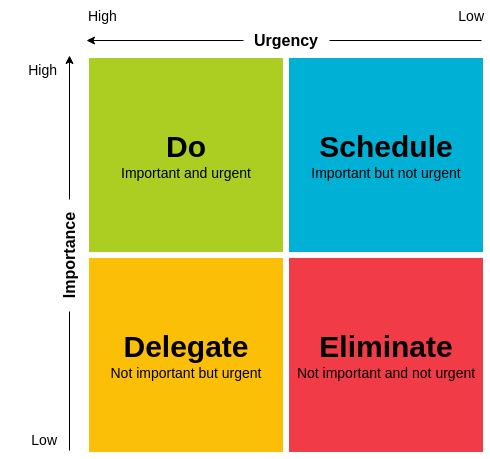
The Eisenhower Matrix is a complimentary method to last week’s Delegation method. It’s a great way to organize an overly full to-do list. Take your tasks and assess them into four categories:
Tasks that are urgent and important - These tasks have immediate deadlines, they have clear consequences, and affect your long-term goals - you should do these.
Tasks that are not urgent but are important - These are the tasks are important to your long-term goals, but have that may have long or ambiguous timelines but don’t need to be done right away - you should schedule these.
Tasks that are urgent but not important - These tasks must be completed now, but don’t affect your long-term goals - these tasks should be delegated.
Tasks that are not urgent and not important - These are trivial tasks that are time wasters or “busy” work. Acknowledging and acknowledgement - Eliminate them.
How I use it
I have the Eisenhower method as part of my intake triage on my to do list. I try to not let things be at rest, lest the tend to remain at rest.
Items for the “Do” column are pretty straight forward, timing, importance or things only I can do go here. You’ll recognize them because they’re stressing you out.
Items for the “Schedule” list are those things that I know I need to get to right after I finish the “Do” items. They’re things coming up that I know I can’t delegate, but have time before I need to get them done.
Items for the “Delegate” list are things that don’t need my bespoke skills or abilities and that I don’t have some personal need to do myself. This is where leaders are made. You make your workload more efficient and effective while giving your team opportunities to shine.
Items for the “Eliminate” list are the things you think you might need to get done, but are really just getting in the way of actually getting work done. It’s work about chasing the status of something or reporting/ communicating about work; skip the meeting about prepping for the meeting, fire off a status update and get to doing the skilled work you should be doing in the “Do” list.
Build a system to enable your team to do the same and create a better culture.
Technology I’m Looking At
Lucy - AI for Knowledge Management
Lucy is an AI-powered answer engine, that aims to "liberate corporate knowledge" by providing the right answer to the right person quickly, by sifting through various documents. Lucy’s most recent version 4 features expands integration with Microsoft Teams and Slack, and includes a unique two-to-three sentence summary of the answer to help you. The goal, according to Lucy’s creatives is to "give time back to the world" and enhance collaboration by allowing annotating and adding context within the tool. The use of generative AI in an answer engine can improve a company's data literacy and increase the return on investment.
The Thin Slice
It reads like a localized AI search engine that sifts through your repos and provides a contextual way to streamline the finding of knowledge. I’d like to think of it as helping to remove the unknown knowns in your organization.
My Opinion
AI is the future. It’s not here yet, it’s not anywhere close to perfect yet. But it’s more than the first couple steps forward. Whether it’s Lucy, Chat-GPT, Google’s Bard, or one of the myriad others, I’m still seeing incorrect and blatantly false information produced by these AI technologies without an inline disclaimer when it’s making a guess (educated or otherwise). The errors are teaching moments that let them get better, but I’d like to see some reminders in the systems that these AIs are guessing or unsure.
Quote I’m Musing

“Speak when you are angry and you will make the best speech you will ever regret.”
- Ambrose Bierce
I was chatting with a friend and mentor of mine and the topic of road rage came up. He’s in Arizona and I remember it being a part of life there as well as well. People in the heat become so frustrated in traffic that they drive themselves to anger, and then exact their own idea of justice, or vengeance, or retribution on their designated offensive party. I think there is no situation in life that can’t be made worse by thoughtless action, and actions derived from anger are just that.
This anecdote applies, I think, even to things like firing off a thoughtless barb while during a conversation, or sending an angry email response.
I’m just as fallible as the next, and I have never felt good about losing my temper or acting in anger after the fact. Never. Marcus Aurelius says in Meditations that we do violence to our soul when we give in to our bad urges, to our tempers, betray our standards. Most of our anger is our Ego reacting to our situation.
SO, before you send that spicy email response, go hit the water fountain and knock out a couple tasks. Come back to it and reread it. Before you decide to enact that vengeance, give it a 10 count.
We don’t control what happens to us, who says what to us, but we control how we react, and WHEN we react. Think about whether you need to have an opinion on it, thing about whether the situation is something you can even control, think about your personal standards, and use the Eisenhower method to determine if you even need to respond.
I would love your feedback!
Which musing is your favorite? What else do you want to see or what should I eliminate? Any other suggestions? Just send a tweet to @erichaupt on Twitter and put #SundayMusings at the end so I can find it. Or, eric@erichaupt.com for long form email.
Have a wonderful week, I’ll see you Sunday.
-e

End of transmission.