Sunday Musings Memento Mori Cyber
Happy Sunday Friend!
Welcome back to another musing! I’m glad you’re here. Here are your Sunday Musings, a quick dose of what I’m exploring and thinking about. If you find it useful, please feel free to forward this along to friends!
Quote I’m Musing

“You could leave life right now, let that determine what you do and say and think.”
-Marcus Aurelius
This sounds much more morbid than it is meant, especially in our very negative thought-spiral induced age.
We are all going to die. Think about the greatest person you believe has ever lived in history. Say their name out loud. They died. They are in the same place that the beggar whose name has been lost to time is. Death is a perfect prophecy.
Thanks Eric; What do I do with that?
Don’t take people, or events, for granted. This isn’t an impetus to disconnect; it’s a reminder to connect deeply with what is truly important. That is the present moment.
One night this past week both of my children came to me in the middle of the night and slept on me. Literally on me, one on each side. In the morning I got up, positive my left arm had ceased to exist and slightly bleary from trying not to move and wake up the small child on my chest.
A friend of mine asked me if it was a terrible night and my immediate response was, “it was an amazing night.”
There will be a night that is the last night my child will seek the comfort of their father at night, and I don’t get to choose when that is.
I’m going to savor these happy burdens as long as I am afforded them.
Cyber Warfare and Modern Conflicts: Hacking the Boundaries of Conflict
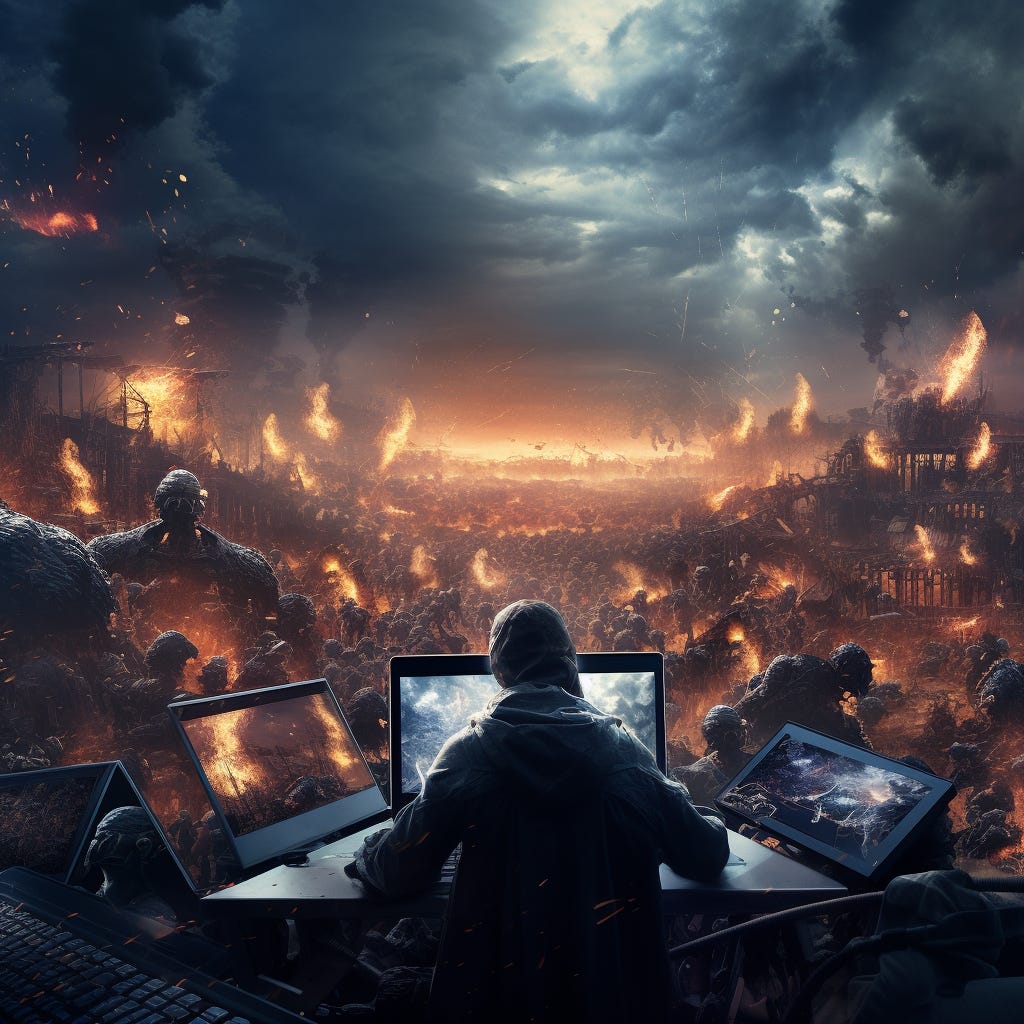
In the dynamic landscape of modern conflict, traditional warfare is increasingly, and irrevocably compounded with a digital battleground. Please allow me a divergence of musing to delve into hacktivism world, specifically in the context of the current Israel-Hamas conflict. Let’s explore how hacktivists have emerged as players, their impact on the overall conflict, and the ethical considerations that parallel their activities.
The Cyber Battlefield Unleashed
In the wake of escalating conflicts, on terra and in the fifth domain, hacktivists have emerged as prominent actors. These individuals and groups engage in a wide range of activities, including defacement, Distributed Denial of Service (DDoS) attacks, data theft, and targeting of internet service providers. Their ultimate goal is to disrupt services and propagate their messages, effectively utilizing the digital sphere as a weapon.
In examining their activities in modern conflict strategies, we find three distinct subsets of hacktivist groups in the Israel-Hamas conflict.
The 'Islamic' Hacktivists
Our first group is comprised of self-proclaimed "Islamic" hacktivists who lend digital support to Hamas and Palestine. These actors have targeted other nation states such as India and have been active in the digital arena for years. Their motivations appear to be grounded in geopolitical and ideological alignment with the Pro-Palestine/Hamas cause.
Pro-Russian Pivots
Our second subset involves pro-Russian hacktivists, recently pivoting to target Israel. Their involvement is interesting, as it suggests a possible attempt to stir chaos and promote Russian state narratives. This shift underscores a nuanced, evolved character of modern warfare, where digital frontlines become a platform for state actors to influence conflicts from within their sovereign borders and, likely, via proxies.
Newly-Formed Groups
Our third subset comprises newly-formed, or new facets of existing, groups that have emerged recently and have limited known prior activities. These opportunists have entered the conflict, aligning with various geopolitical interests. Their motivations and affiliations are often fluid, and they adapt to the evolving dynamics of the digital battlefield. I imagine their tactics, techniques, and tradecrafts to be uncovered and attributed in the next 60 days or so.
Theories on War
Carl von Clausewitz argued that war is a continuation of political activities by other means. Contextually, hacktivism represents a contemporary extension of politics into cyberspace. While his theories primarily focus on conventional warfare, they are still relevant in understanding the character and nature of modern conflicts, including those in the digital domain.
The very essence of war is defined by friction, uncertainty, and the pursuit of political objectives. The same principles apply to hacktivism; it's a means of pursuing political objectives through digital means, often with uncertainty surrounding the results. In the Israel-Hamas conflict, hacktivists aim to influence the political narrative through their activities in the digital realm.
In cyber warfare, Marcus Aurelius and Epictetus can offer unique insights. Stoicism teaches us to maintain composure and focus on our principles. It's a reminder that while hacktivism can create chaos and disinformation, its true impact on the overall conflict remains limited to vectoring attention and attempts to control narratives. These are elements of an adversarial force focused on what they can control in areas where their foe has the least control.
Ethical Guidelines in the Digital Landscape
The International Committee of the Red Cross released rules of engagement for "civilian hackers" participating in conflicts, emphasizing the importance of minimizing threats to civilian safety, and banning cyberattacks on healthcare facilities. These rules aim to provide ethical guidelines in the complex digital landscape.
These guidelines remind hacktivists of the importance of minimizing harm to innocent civilians and adhering to ethical standards, even in the heat of battle. The parallel to Clausewitz's theories is clear; modern warfare, whether physical or digital, should always remain a means to a political end rather than an end in itself.
Hacking the Boundaries of Conflict and Ethics
Hacktivism is a stark reality in modern conflicts, with myriad groups and individuals partaking to advance their agendas. It's an extension of politics, or will, into the fifth domain, and its impact on the overall conflict, while disruptive, remains limited for now. The trend underscores the importance of addressing the role of hacktivism in warfare and establishing ethical guidelines to minimize harm to civilians.
As we navigate the complexities of a hybrid battlefield, it's crucial to recognize that war, in all its forms, is a means to political ends.
The world of hacktivism is a digital frontier where the lines between conflict and ethics are being defined and discovered. Just as Soldiers on traditional battlefields are guided by principles of conduct, hacktivists must embrace their own code of ethics to ensure that their actions, however disruptive, remain within the bounds of morality and reason. In this dynamic landscape, the principles of ancient philosophy and modern military strategy are as relevant as ever.
Shoot Me Your Feedback!
Which musing is your favorite? What else do you want to see or what should I eliminate? Any other suggestions? Just send a tweet to @erichaupt on Twitter and put #SundayMusings at the end so I can find it. Or, eric@erichaupt.com for long form email.
Have a wonderful week, I’ll see you Sunday.
-e

End of transmission.