Sunday Musings On Establishing And
Happy Sunday Friends!
Here you’ll find 1 quote I’m musing, 2 Ideas, 3 of my favorite things from the week, and 1 question. If you find it useful or interesting, please feel free to forward this along to some friends or others!
One Quote I’m Musing
“We should not, like sheep, follow the herd of creatures in front of us, making our way where others go, not where we ought to go”
- Seneca
Had the opportunity to talk about culture for several hours during my travel through North Carolina this past week. Existing cultures, establishing cultures, what makes a culture (good or bad), and what transforms a culture.
I took these conversations home, chatted with Solana about them too and our continued conversation helped me break down the culture creation/establishment into three key elements.
Clear Vision, Values, and Goals - Who Are We? If we can’t state it simply and clearly, that’s a friction point to nudge up to baseline.
People follow those who they perceive as having the same or similar values and goals. That’s how we get mentors, mentees, and coaches.
René Girard uses mimetic theory to point out that while we think we choose autonomously, uninfluenced by others, most of our desires are metaphysical and mimetic because they mimic them from those around us. A celebrity, a model, a mentor, a philosopher, an athlete, or even a life-long friend. Put another way, most of our desires are derivative. Instead of “I want that”, we have an “I want that because someone I look up to or admire wants or has it”.
We long to become people who are remembered, who make a difference, who are good or great at things we desire to be great at. These ideas are usually very abstract and seem difficult to achieve, so we anchor these ideas with objects and models we think have already achieved these goals.
I’m not prompting us all to go be sociopaths, I’m using mimetic desire to point out that when we clearly articulate our vision, values, and goals (our Why) we attract those who align with them. When we are vague, when we are malleable in them, so becomes the culture, and all of those (including us) who are in it.
Who are our Heroes, what are our Stories? Capture the Stories and the Heroes that make us who we are. Culture is predominantly made up of stories from the past (what we’ve done), what we want to do, and how we’re going to do it. The real value is to find the heroes, the stories about what we’ve done and bring them into the light. Because desire without action is just a wish.
When I was a Corporal in the Marine Corps, way, way back when. Every newly promoted Non-Commissioned Officer worth their salt read a publication called “The Squad Leader Makes the Difference”. They talked about squad leaders being key to small unit tactics and leadership, then wrote a book full of stories on how they made the difference.
We should be able to walk our halls, our locations, with our people and point out things from our past. Operations, missions, people, programs, developments. “We did that in 2008. That woman single-handedly created this feature that saved her whole section. Ooh, that was a bad year, here’s what we learned. This guy has been here for 35 years, he knows where all the skeletons are, because he is the one who buried them.”
These create the positive culture Richard Branson envisioned when he said to train your people so well that they don’t need you but treat your people so well that they don’t never want to leave.
Lastly, Know Your People.
Understand the Law of Diffusion of Innovation. Developed by E.M. Rogers in 1962 and experiencing another resurgence thanks to Simon Sinek.
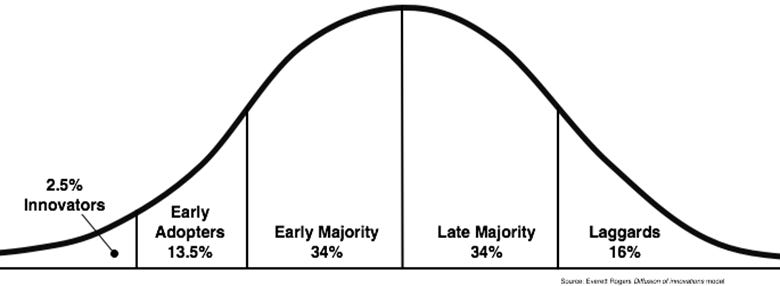
The idea is the same for technology as it is for cultures.
The first 2.5% are the big idea folks, the dreamers. They want to be the first to try the innovation. They’re willing to take risks, and nothing needs to be done with them, they’re just going to be on board. Everyone loves them.
The Early Adopters representing the next 13.5% are opinion leaders. They’ll sacrifice for things that align with their beliefs. They are already aware of the need to change and are comfortable adopting new ideas.
The next two are typically cynics. Our Early Majority are the folks who will follow the positive results of the first 16%. The Late Majority are our bandwagoners, they’ll go when the positive outcome looks close-to or inevitable.
Then there’s the Laggards. They’ll go only because they have to (I see you, blackberry holdouts).
Where I see the culture conversation go south, is that many organizations are focused on the bulge. That is 68% in the middle.
Instead, I posit that we should be targeting only the left most 16%. Those are the ones who, once on board, will advocate without extra money, take on extra hours, and convince the early majority folks (who are led largely by mimetic desire) that what we’re doing is awesome. Create the demand and tip the scales from 16% to 50+%.
Aim small miss small. Go for the big percentage, miss the whole thing. Go for the small (but evocative) percentage, maybe miss the perfect bullseye, but still hit your target.
That’s it, I think. Have a clear understanding of who you are (and why you exist). Know your history, vision, and who your people are, then understand who your cultural and opinion leaders are.
Remember, culture is an internal mechanism. It comes from inside your company. Above all, ensure that the bonds you’re forging inside your culture aren’t simply pleasant fictions.
-e
Two Ideas From Me
A couple quick prompts to use for yourself to help with key decision making.
We cannot change everything. But we can control what we can control in our environments. We can ensure that those around us (our boss, our peers, and our subordinates) feel supported and feel like they’re a part of something bigger than themselves.
Being the leader we wish we had, for the organization we share values with creates a bench of future leaders who had the leader they needed to become the leader their subordinates need.
Three Favorite Things From Others
A Five Year Retrospective on Detection as Code | David Burkett of Magonia Research offers a compelling reflection on the past five years of Detection as Code, highlighting significant advancements and practices that have shaped the field. Burkett emphasizes that detection logic can be effectively written in formats other than traditional programming languages, citing Sigma's use of YAML as a prime example.
He underscores the critical role of code review and continuous integration/continuous deployment (CI/CD) processes in maintaining high standards for detection logic. Moreover, Burkett advocates for test-driven detection (TDD), where tests are written before the detection rules themselves to ensure new detections function as intended from the outset.
Burkett also explores the potential of large language models (LLMs) to enhance detection logic. These models can ensure context accuracy, identify technical errors, suggest improvements, and tag detection logic with relevant MITRE ATT&CK IDs. They even have the potential to catch logic errors, such as incorrect regex patterns, further refining the detection process.
Insufficient sun exposure has emerged as a significant public health concern, potentially contributing to hundreds of thousands of deaths each year in the US and Europe. A recent study highlights the heightened risk of various diseases, including cancer, cardiovascular disease, and multiple sclerosis, linked to inadequate sunlight.
While vitamin D has long been recognized as the primary benefit of sun exposure, the study suggests that other mechanisms, such as the release of nitric oxide from the skin, might also play crucial roles in maintaining health. This new understanding underscores the importance of balanced sun exposure for overall well-being and disease prevention. | NCBI
“When a person can't find a deep sense of meaning, they distract themselves with pleasure.” | Viktor Frankl
One Question
Who or what made you want to pursue the path you started on and how can you translate that to where you’re at now?
Have a wonderful week,
I’ll see you Sunday.
-e

End of transmission.