Sunday Musings Quantity Vs Quality
Welcome to another Sunday Friends! I’m glad you’re here.
Here is your Sunday Musings, a quick dose of what I’m exploring and thinking about. Please feel free to forward this along to friends.
Quantity or Quality? - A Concept for Learning
James Clear tells of a professor at the University of Florida who split his photography class into two groups. One group would be graded on how many shots they took and developed. The professor would add up the photographs submitted. Students turning in 100 receiving an A, 90 photos earning a B, and so on. The second group would be graded on the composition of their shots. They could submit as little as they wanted, but their submissions needed to be nearly perfect. At the end of the term, they would bring together all of the photos and pick the “best” ones. Which group do you think produced the best photos? Quantity or quality group?
Turns out, the quantity group best photos. Is it better to focus on finding one solution that would work or multiple that might have the elements necessary for the best solution?
The quantity students took lots of photos, experimented, varied their composition, and improved incrementally. They were learning, empowered by their own feedback loops, and producing great work after many, many failures. Novel ideas and approaches are at the heart of innovation.
I know I’m as guilty as the next in worrying over making a mistake or not wanting to act until I have the perfect solution. This analysis paralysis gets us all at one time or another, but we have to remain self-aware enough to see it and take action. Like I said last week, there’s a point where you must start doing. Start with repetition, work towards perfection.
Want to get better at photography? Take 10,000 photos. Learning how to cook? Try 100 new recipes. Public speaking (everyone’s biggest fear)? Make 50 public speeches. At the end (and with a few internet tutorials), you can’t help but be significantly better.
Have an amazing week!
-e
P.S. Thanks to you all for reaching out and/or congratulating me on the big position shift!
Technology I’m Looking At
AI in Art and Pushback
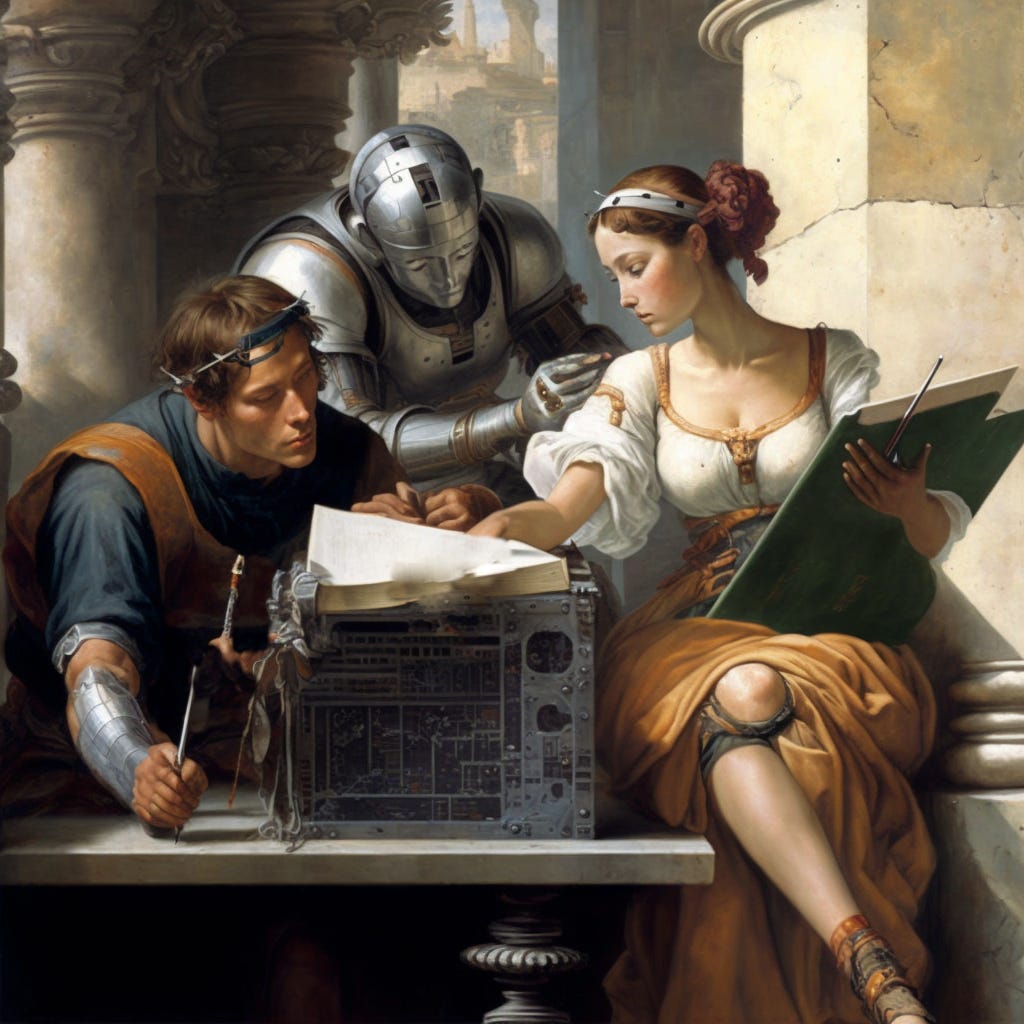
AI art has been all over the news and social media. Whether you’re for or against it at the moment, I think it’s important to see both sides have very valid points in their arguments. Pulling from Aristotle, it is the sign of an educated mind to entertain a thought or point of view without accepting it.
Pro AI Art:
AI-generated art has the potential to revolutionize the art world and open up new possibilities for creativity and expression.
The main benefit of AI-generated art is that it can help democratize the art world. AI algorithms can be trained on a wide variety of data, making it possible for anyone with access to a computer and the right software to create unique, original works of art. People who may not have the traditional skills or resources create art, can still participate in the art world with their unique perspective and story-telling abilities.
AI-generated art can expand the range of styles and forms that are possible within the art world. By learning from a wide variety of data sources and drawing on different artistic traditions, AI algorithms can produce art that would otherwise be nearly impossible for humans to create. This might lead to entirely new styles and forms of art, or new avenues for creative expression.
AI in the creating art could bring new voices and perspectives to the art world, inspire and challenge traditional ways of thinking. While it is important to consider the ethical concerns that have been raised about AI-generated art, the benefits of this technology should not be overlooked.
Anti AI Art:
AI-generated art may lead to the exploitation of human creativity. If AI algorithms are trained on the work of human artists, it will be difficult for those artists to receive proper credit or compensation for their work. The proliferation of AI-generated art will displace human artists, as more and more people turn to AI.
AI-generated art might homogenize art styles. If AI algorithms are trained on a narrow range of data, they’ll produce art that is systemically similar in style or subject matter. This would seriously set the art world back from a loss of diversity and reduced range of perspectives and represented voices.
Lastly, the ethical concerns related to the creation of AI-generated art. Plagiarism: while humans direct AI to create the art, they aren’t actually drawing, or painting the work. This creates questions plagiarism when an AI work is published but not properly disclosed as AI-generated. Copyright: AIs are trained using existing images, and artwork; nearly all created by humans. Many artists are unhappy at finding their work either used to train AI systems or have been attributed to work they haven’t produced. AIs are not creating new works, but creating derivative works based on existing images.
Conclusion:
I’m a technologist, I’m excited for the opportunities innovation and technology brings. The ability to rapidly generate art for even this blog is amazing; the fact that it’s limited only to my ability to describe what I want and technical acumen to manipulate the system is even better!
I don’t think the art community are quite the 19th-century Luddites of the textile industry the AI proponents would have you believe. It is natural to be hesitant about adopting new technologies, especially if you think it may disrupt your current way of life or job. However, it is important to consider the potential benefits of new technology.
For example, new technologies can often lead to increased efficiency and productivity and may create new job opportunities. It is also important to consider the potential negative consequences of not adopting new technologies, such as falling behind competitors or missing out on important innovations.
There are some things to figure out in employing Artificial Intelligence; there are going to be failures along the way, there will be successes. The decision to adopt new technology should be based on a careful evaluation of the potential benefits and negatives as well as ensuring we aren’t needlessly marginalizing or exploiting a demographic, rather than blindly accepting it on faith or rejecting it out of fear or resistance to change. I for one think it will turn out to be a boon once we get it right.
I’d love to hear your thoughts!
Quote I’m Musing
“Ah, but a man's reach should exceed his grasp, Or what's a heaven for?”
-Robert Browning

Simply, there is success in failure. Two of my favorite points to drive home when I’m discussing leadership come to mind here.
F.A.I.L is an acronym, not a verb. When practicing disciplined initiative, it is your First Attempt In Learning.
Leaders MUST underwrite honest mistakes and/or failures. The idea of someone doing any endeavor perfectly, without help, without experience, the first time (or while they’re still learning) is a fallacy.
Wrapping this up. If people always waited for the perfect answer before even starting, humanity wouldn’t still exist. Uber, Tesla, Ford, any major business wouldn’t exist. We need innovation, it’s what makes humans great; that only comes from the freedom to F.A.I.L. It’s on you as a leader to create that environment.
Which musing is your favorite? What else do you want to see or what should I eliminate? Any other suggestions? Please let me know. Just send a tweet to @erichaupt on Twitter and put #SundayMusings at the end so I can find it. Or, eric@erichaupt.com for long form email.
Have a wonderful week, I’ll see you Sunday.
-e

End of transmission.