Sunday Musings Seeing Through Muddy
Happy Sunday Friend!
Welcome back to another musing! I’m glad you’re here. Here are your Sunday Musings, a quick dose of what I’m exploring and thinking about. If you find it useful, please feel free to forward this along to friends!
Quote I’m Musing

[Referencing finding drinking water from a muddy river]
“Wait and let her be. So the mud settles on its own, and you have clean water. Your mind is like that too! When it is disturbed, you just have to let it be. Give it some time. Do not be impatient. It will find the balance by itself.”
-Buddha
Take time to think and reflect. Jim Mattis (Secretary of Defense and USMC General) said that the biggest problem facing today’s leaders is the lack of space for reflection, solitude, and silence.
We aren’t taking the time to think about the problem, to reflect on our experiences, and let the situation evolve (or settle itself) when we react and respond immediately.
My challenge to myself is to continue to work at being nonreactive. Take the time to think about what I think before I express or take action. Give the ability to zoom out, and zoom in on the situation, to reflect. Then, like a glass of muddy water, take the time settle to see clearly.
The Importance of Systems
Why are Systems Important?
I’ve spent the last two weeks discussing with my new superiors, peers, and subordinate leaders and their teams. Key to my understanding how, where, and why I fit in comes down to understanding 7 key items:
What Functions do you/your team provide?
What do your Functions look like over time and space?
How do you keep everything you do organized in:
Day to Day
Times of churn and turnover
What is the vision you’re supporting?
How do you figure out what you need to do your functions?
How do you prioritize?
How do you organize your data / What does your knowledge management look like?
I didn’t expect to have a full list of answers from my engagements. I don’t think I could have answered more than one or two questions when I was where they were 8-10 years ago. I was pleasantly surprised with some very organized people, some very less organized people, and a lot of in between.
This series of engagements wasn’t to show how bad anyone was, it was to gain an honest assessment of where we’re at amongst all my teams, strengths, weaknesses, and interoperability. Knowing this, we can collaborate on where to achieve organizational goals and vision.
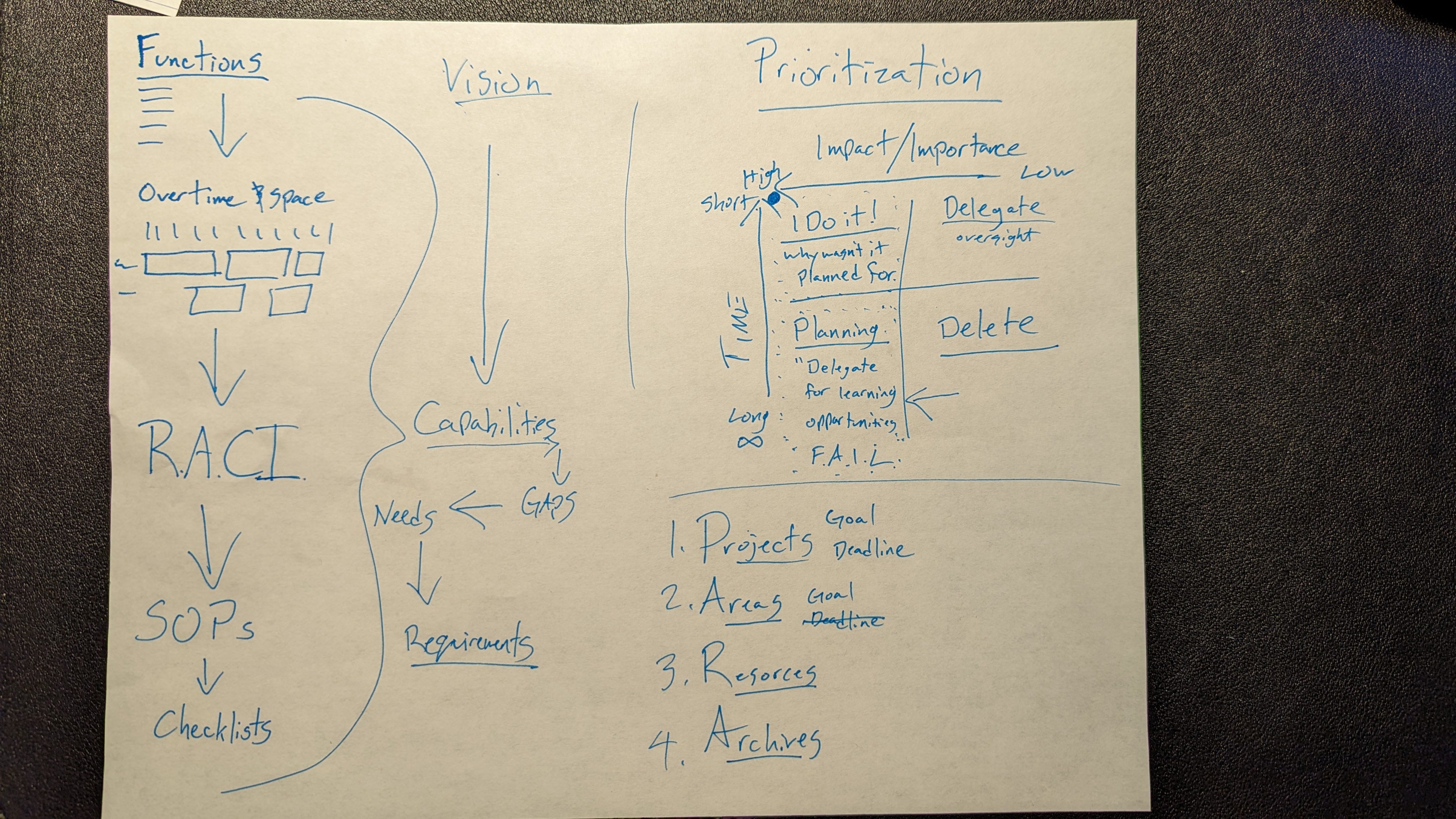
I spent several hours talking through the importance of having a system, any system, that is sustainable and repeatable. Where a team or leader was lacking, I articulated what I do. I drew out my system of systems many, many times and I thought I’d take a break and put it up for all you friends to scrutinize and (hopefully) provide some alternative perspectives and insights.
How I do it
I combine all seven elements of the questions above into a system using Gantt Charts, R.A.C.I charts, and CAPDEV methodologies for developing requirements. I prioritize using the Eisenhower Matrix, and I organize my information using Tiago Forte’s P.A.R.A system.
Easy, right? I’ll break it down below!
Breaking Down What I Do
Building my System of Systems
1. Functions
First, I list out everything my team does, I do, or I’m involved in. Think of it as “Anything that you spend any amount of time on” during your day or week.
2. Over Time and Space
Then I take that list and I map out all the projects over a calendar (fiscal year for me). Yes, there are things we do that take up time but aren’t mappable. Those stay on the Functions list and get further developed in the next product.
3. R.A.C.I.’ing
For every Function I perform, I employ a RACI matrix to clarify expectations, avoid confusion, and improve communication and collaboration amongst project stakeholders. It helps me monitor and control projects and functions. Each letter denotes a degree of involvement.
Here’s what each designation means:
Responsible
The person who does the work to complete the task or create the deliverable. Every task should have at least one responsible person or team.
Accountable
Delegates, reviews, and approves the work. They make sure the responsible person or team knows the expectations and completes the work on time. There should only ever be one Accountable person.
Consulted / Contributor
Consulted people provide input and feedback on the work. They have a stake in the outcomes of a project and the results will affect them.
We consult these stakeholders when planning, and periodically throughout the function or project to get input, throughout the timeline, and at completion for feedback on the outcome.
Not every function or project has a consulted party, but we should consider all possible stakeholders when beginning a new endeavor and include consulted parties as appropriate. I limit this to only necessary input, however, and jealously guard my teams’ time against too much input and opinion.
Consulted parties could be individuals on the team who aren’t working on the specific function or project whose work will be affected by the outcome. Also, they’re often individuals or teams outside the team or organization who will have an influence on the success or failure of the project.
Informed
These folks need to be looped into my progress but not consulted or overwhelmed with the details. They need to know what’s going on because it could affect their work, but they’re not decision makers in my process.
Informed parties are almost always outside of the project team and often in different departments or organizations. Think directors of affected teams and senior leadership.
4. Standard Operating Procedures and Checklists
Knowing what I do over time and space and who is involved lets me create very effective SOPs. For every SOP to be effective beyond my team or me doing them, I create a checklist for everything we do. This way, when my superstars are out sick (inevitably when we need to do it with short notice), I can muddle through it and complete the job at an acceptable level.
Now we know where we are and where we’ve been. Next is understanding where we’re going.
Getting to What I Need
From Leader’s Vision to Team Requirements
1. Vision
Every organization must have a guiding vision. A leader unwaveringly pointing towards that spot on the horizon where we are going to go. This is essential. No matter what leadership style any of us claim, we cannot lead effectively if we cannot show people where we’re going in a way that guides them there.
2 Capabilities Development Process
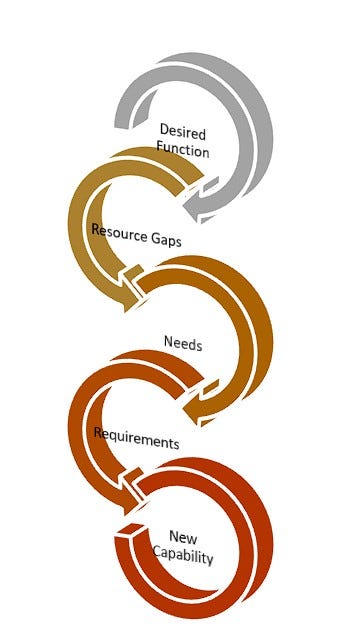
We know where we are and what resources we have, and we know where we need to go. Now we have to determine if we have the resources to get there.
Starting at the top, we have the Function desired of us.
I account for the resources available and determine how far that gets us to the new function we need to perform.
The gap between resources available and the desired function is the Need.
I determine what additional resources are necessary and those become the Requirements.
Once I’ve obtained the necessary resources to do the Function, I develop the new Capability.
I do this analysis through new capability process for every function in my arsenal.
Stopping here, with effective functions, SOPs, and understanding where I am and where I’m going, I can be confident in my ability to be effective in nearly any situation.
To be confident in ANY situation, I employ two more systems. Prioritization, and organization.
Prioritizing it All
I have more than 300 people, I have 300+ top priorities
1. Eisenhower Matrix
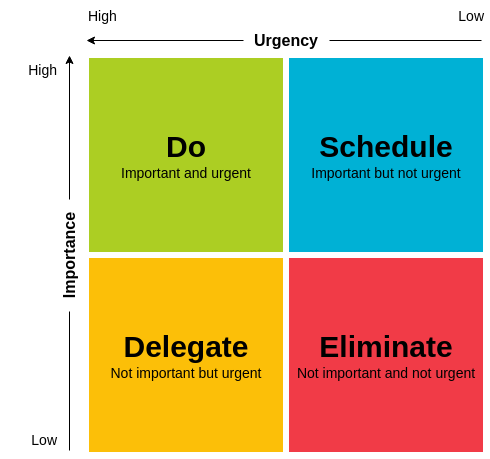
It’s simple, it’s effective, and it’s efficient. If it’s good enough for a Wartime General and President, it’s good enough for my simple self.
I have the Eisenhower method as part of my intake triage. I try to not let things be at rest, lest they remain at rest.
1.1 Do
Items in my “Do” column are fairly straight forward, timing, importance or things only I can do go here. You’ll recognize them because they’re stressing you out. Subtext is “Why didn’t I schedule this!?”
Many people think we should be living here, in the DO. But I think this is an indicator of a failing system. We should be living in the next one box.
1.2 Schedule
Items for the “Schedule” list are those things that I know I need to get to right after I finish the “Do” items. They are things coming up that I know I can’t delegate but have time before I need to get them done. By living here, scheduling and planning, I give myself and those around me time to think. I also create a buffer against the emergencies that are always in the DO box.
I’ve recently modified this area. Because we have time, this is also an opportunity to delegate. Give a subordinate or peer the opportunity for a F.A.I.L forward and potentially add a new skill.
1.3 Delegate
Items for the “Delegate” list are things that don’t need my bespoke skills or abilities and that I don’t have some personal need to do myself. This is where leaders are made. You make your workload more efficient and effective while giving your team opportunities to shine.
1.4 Eliminate
No one’s tracking it and there’s no due date. Items for the “Eliminate” list are the things you think you might need to get done but are really just getting in the way of actually getting work done. It’s work about chasing the status of something or reporting / communicating about work; skip the meeting about prepping for the meeting, fire off a status update and get to doing the skilled work you should be doing in the “Do” list.
Organizing for the Long Term
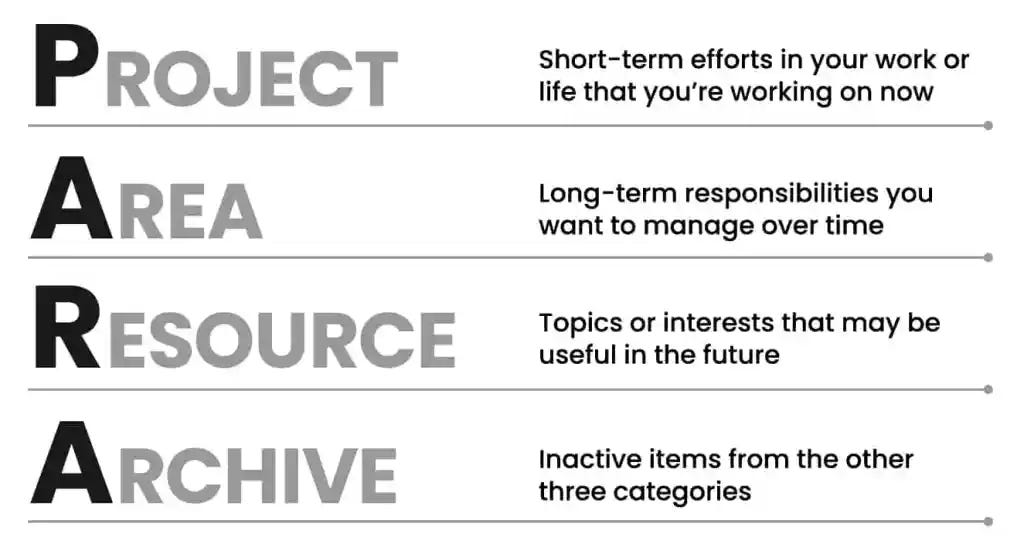
I very much enjoy a clean filing system. I’ve tried a huge number of them. Tiago Forte’s P.A.R.A Method works about as close to perfect for me as I can get.
If you open my drive, you find only the four folders above (my staff can attest to this as I’ve shown them).
1. Projects
I use this folder only for projects that I am personally actively working on that have a short-term deadline and have a specific goal.
Write a paper
Revamp Website
Build new template
Remodel bathroom
2. Areas
I use areas for aspects of my work and life that require my attention. They are ongoing, cyclical, or projects of others that I’m the accountable party for.
Staff Divisons/Sections
Finances
Car
House
Research and Development
3. Resources
My resources are a diverse range of things I’m interested in
Productivity
Leadership
Quantum Computing / Encryption
Why 42 is the answer
4. Archive
Archive is where I put anything from the previous three categories that aren’t active anymore, but I want to reference later.
Projects on hold
Areas I’m no longer responsible for or are no longer relevant
Resources I’ve lost interest in
Wrap Up
All of these may seem overly simplified. But that’s the point. Our lives are complex, hectic, and chaos. If our systems were any of those three things, they would fail. Or worse, they’d soak up the time and energy we need to live our lives.
Here’s a mid-session photo of my 8.5”x11” paper I doodled on while I walked through my process with one of my teams.
I would love your feedback!
Which musing is your favorite? What else do you want to see or what should I eliminate? Any other suggestions? Just send a tweet to @erichaupt on Twitter and put #SundayMusings at the end so I can find it. Or, eric@erichaupt.com for long form email.
Have a wonderful week, I’ll see you Sunday.
-e

End of transmission.