Sunday Musings Taking A Moment The
Happy Sunday Friend!
Welcome back to another musing! I’m glad you’re here. I’m going to get a little personal and direct this week. We had a recent suicide in the circle, and it hits hard. I had a whole Musing ready to go and am now rewriting this at 9pm Sunday, a few hours after I received the news; please forgive any lack of polish as I attempt to posit a background, potential reason, and framework. I will do my best to provide links to further define and provide evidence-based thought.
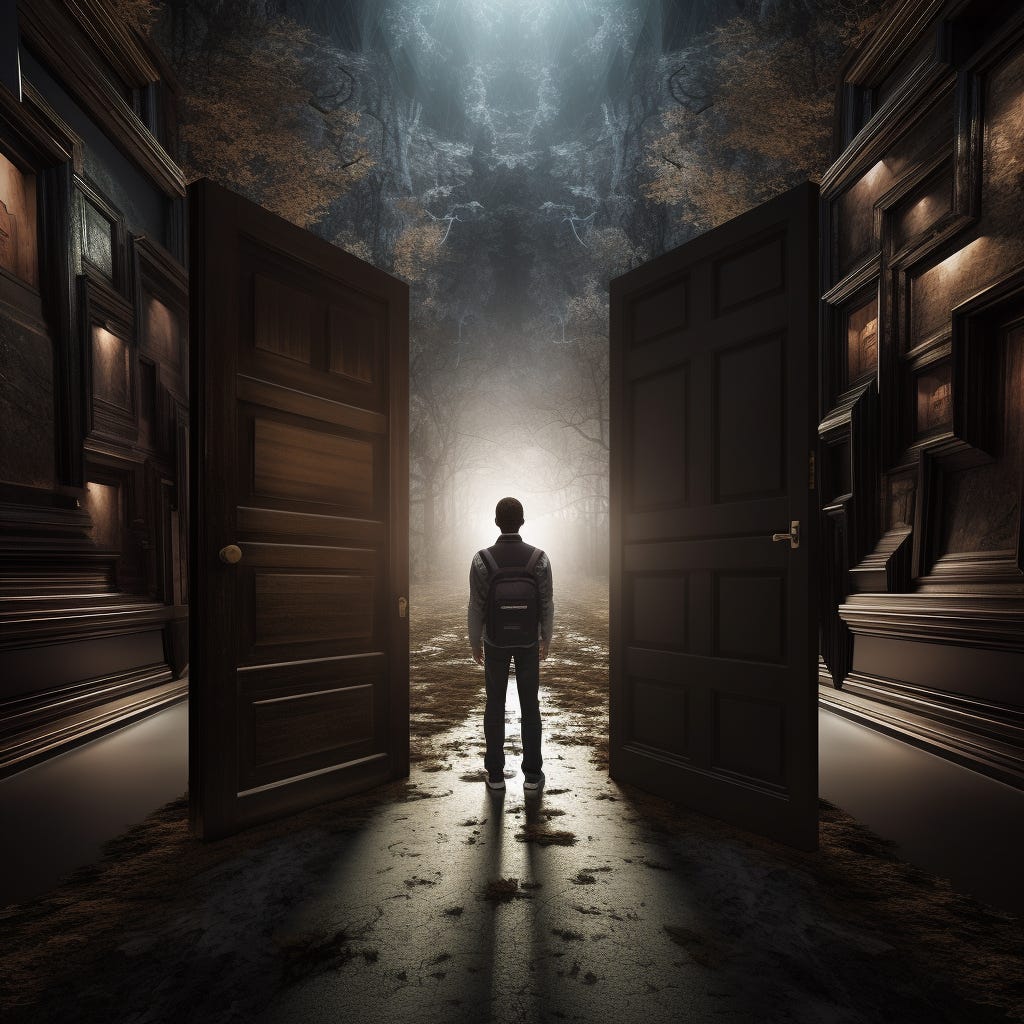
Two Open Doors
All too often, especially in the military and retired military, our friends, family, pleasant acquaintances, coworkers fall to the unreasonable silence of the universe. It occurs to me that many of us, me included, feel driven by being useful. Useful to others, making the world a better place, in our relationships, and acting as the moral agents of Logos. The striving of purpose and finding meaning in that purpose of what we do that lets us blissfully surpass the inevitability of oblivion and death.
When we end our struggle, whether in retirement, death, traumatic event, or collapse of something that used to give us meaning, what is left? Alber Camus discusses this in The Myth of Sisyphus. We come to a feeling of dread and frustration when we recognize that someday we’ll die and be forgotten - either immediately or on the grand scale of time and existence. It can make life feel suddenly irrelevant, even absurd. Also known as existential crisis, which can lead to depression, impulsiveness, and self-destructive behavior.
“We build our life on the hope for tomorrow, yet tomorrow brings us closer to death and is the ultimate enemy; people live their lives as if they were not aware of the certainty of death. Once stripped of its common romanticism, the world is a foreign, strange and inhuman place; true knowledge is impossible and rationality and science cannot explain the world: their stories ultimately end in meaningless abstractions, in metaphors. This is the absurd condition and from the moment absurdity is recognized, it becomes a passion, the most harrowing of all."
“It is not the world that is absurd, nor human thought: the absurd arises when the human need to understand meets the unreasonableness of the world, when the appetite for the absolute and for unity meets the impossibility of reducing this world to a rational and reasonable principle."
-Excerpt from The Myth of Sisyphus by Albert Camus
I posit that there are three possible responses when confronted with Camus’ absurd realization.
We can, as Camus supports, commit to living without hope. If this is your method check out Mark Manson’s book Everything is F*cked. He argues that unhappiness comes from comparing ourselves to others and striving for change that might not be possible.
We can seek meaning via philosophy and religion. If this is you, check out Marcus Aurelius’ Meditations and Epictetus’ Discourses.
Finally, we can seek to reject or escape through suicide. An example of rejection is the Buddhist disciple Nhat Chi Mai, one of the people who burned themselves to death in order to bring light to, and protest the persecution of Vietnamese Buddhists. Will Hall has a decent writing on suicide as an escape. I recall the escape thoughts in conversations long ago during the September 11 attacks in New York. The image of The Falling Man captures my thoughts.
It’s not the desire for death. It’s the overwhelming fear of, or inability to cope with, the fires and smoke so high up in those towers that made jumping from such heights a viable option at that moment.
As for me, I find myself pulled to Stoic philosophy.
Epictetus says “Don’t believe your situation is genuinely bad - no one can make you do that. Is there smoke in the house? If it’s not suffocating, I will stay indoors; if it proves too much, I’ll leave. Always remember - the door is open.”
We always have a choice. But it is up to us; I find it difficult to believe anyone can understand that last, eternal, choice until we are in that moment. I tend to side with the Stoics; not finding suicide, as an act, morally or ethically reprehensible act in the extreme cases.
In Discourses, Epictetus goes to a friend when he learns that he is starving himself to death (this was common back then). He begins to understand that this was not one of the extreme cases and tells his friend “If your decision is justified, look, here we are at your side and ready to help you on your way; but if your decision is unreasonable, you ought to change it.”
I can’t tell you what reasonable suicide is. I’m just not that brilliant. Cato the Younger committed suicide to keep from being used as a political pawn by Caesar. Seneca tells Lucilius of a Spartan who kills himself rather than live as a slave. The Buddhists immolated themselves to bring light to and stop persecution.
Beyond any of my beliefs or foundations in the great stoics, I think Simone de Beauvior delivers eloquently in The Mandarins another personal responsibility I feel. “My death does not belong to me, it’s the others who would live my death”.
Ultimately, none of us know when our time is complete. I think that is precisely why we should be present; live every moment we have. Endeavor to not waste the only resource we cannot hope to renew: time.
As Seneca said: “Hold every hour in your grasp. While we are postponing, life speeds by.”
As a final note, if you feel you are in a situation where that room is too smoky, you have two open doors available. One is singular in its finality. The second open door is your friends; get a second opinion. We may help you realize that the decision, however true in the moment, is unreasonable, and you ought to change it. I’ll accept your choice, but I hope you trust your friends.
Have a wonderful week, I’ll see you Sunday.
-e

End of transmission.